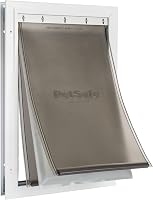
9 Best Dog Doors for Large Dogs (November 2026)
The best dog doors for large dogs include the PetSafe Wall Entry Pet Door for homes needing wall access, the PetSafe Extreme Weather Aluminum Dog Door for draft-prone exterior doors, and the PetSafe Plastic Dog and Cat Door for thinner compatible doors.
On this page (8 sections)
- Which dog doors for large dogs made our list?
- The best dog doors for large dogs
- How do you choose a dog door for a large dog?
- How should you prepare for installation?
- How do you help a large dog use the opening?
- What care keeps a large dog door working properly?
- Which mistakes should you avoid before buying?
- Which large dog door should you choose?
The PetSafe Wall Entry Pet Door, Large is our top dog door for large dogs when you need wall access and its opening fits your pet. For a broad-chested dog using an exterior door, start with the wider PetSafe Plastic X-Large or Ideal options.
Choose by your dog's body measurements and the installation location, not the word “Large.” A high weight limit cannot make up for a narrow flap or a step-over your dog struggles to clear.
Use our dog door size chart to plan clearance. If the best exit isn't through an existing door, compare wall mount vs door mount dog doors before choosing a model.
Our picks at a glance
-
1
 Best for homes needing wall access
PetSafe Wall Entry Pet Door, Large
8.6/10 our score
See it on Amazon -
2
 Best for draft-prone exterior doors
PetSafe Extreme Weather Aluminum Dog Door, X-Large
8.5/10 our score
See it on Amazon -
3
 Best for thinner compatible doors
PetSafe Plastic Dog and Cat Door, X-Large
8.4/10 our score
See it on Amazon
- 4
 Check it
Baboni Metal 3-Flap Dog Door, X-Large
Best for exposed back doors - 5
 Check it
Ideal Ruff-Weather Super Large Pet Door
Best for broad-chested dogs - 6
 Check it
Perfect Pet All-Weather Super Large Dog Door
Best for roomy side-door access - 7
 Check it
MIAOTONG 3-Flap Never Rust XL Dog Door
Best for tall dogs - 8
 Check it
Eillion Extra Large Dog Door, 220 lb
Best for planned door replacements - 9
 Check it
VOSOIR Aluminum XL Exterior Dog Door
Best for scheduled outdoor access
Which dog doors for large dogs made our list?
The PetSafe Wall Entry ranks first for a suitable wall installation, while the other picks serve different door openings, body shapes and weather needs. Eliminate any model that fails your measurements before comparing its other features.
OpenOttoman compared clear openings, installation ranges, flap arrangements and closing panels. The order reflects those features and their usefulness for large-dog households; your installation must still match the product.
The table separates pet clearance from installation thickness. Neither tells you the cutout size, which must come from the exact model's installation template.
| Product | Best for | Flap opening | Installation thickness | Flap design | Our score |
|---|---|---|---|---|---|
| PetSafe Wall Entry Pet Door, Large | homes needing wall access | 10 1/4 x 16 1/4 in | 4 3/4–7 1/4 in walls | Double flap | 8.6 |
| PetSafe Extreme Weather Aluminum Dog Door, X-Large | draft-prone exterior doors | Confirm X-Large dimensions before buying | 1 1/2–2 in doors | 3 adjustable flaps with magnetic seal | 8.5 |
| PetSafe Plastic Dog and Cat Door, X-Large | thinner compatible doors | 13 5/8 x 23 5/8 in | 1/16–2 in doors | Single flap | 8.4 |
| Baboni Metal 3-Flap Dog Door, X-Large | exposed back doors | 13 19/64 x 23 19/32 in | 1 3/8–1 57/64 in doors | 2 vinyl flaps and insulated middle flap | 8.1 |
| Ideal Ruff-Weather Super Large Pet Door | broad-chested dogs | 15 x 23.5 in | 3/4–1 3/4 in doors | Double vinyl flaps | 8.1 |
| Perfect Pet All-Weather Super Large Dog Door | roomy side-door access | 15 x 23 1/2 in | 3/4–1 3/4 in doors | Double vinyl flaps | 8.0 |
| MIAOTONG 3-Flap Never Rust XL Dog Door | tall dogs | 14 1/2 x 24 7/8 in | 1.2–2 in doors | 3 flaps with magnetic closure | 7.4 |
| Eillion Extra Large Dog Door, 220 lb | planned door replacements | 13.4 x 23.1 in | 1.2–2 in doors | 3 flaps with magnetic seals | 7.3 |
| VOSOIR Aluminum XL Exterior Dog Door | scheduled outdoor access | 23.7 x 16.2 in; confirm width and height | 1.26–2.08 in | 2 flaps with magnetic closure | 7.0 |
The best dog doors for large dogs
Choose the model that fits both your dog and your home, even when that means skipping a higher-scoring pick. Each option below has a different reason to buy and a clear reason to pass.
PetSafe Wall Entry Pet Door, Large: Best for homes needing wall access
- Wall installation
- 10 1/4 x 16 1/4 in flap opening
- Telescoping tunnel for 4 3/4–7 1/4 in walls
- Double flap and slide-in closing panel
Choose this wall-specific model when a human door is in the wrong place. Its smaller opening suits dogs whose measured body size fits comfortably, within the 100 lb limit.
Pros
- Telescoping wall tunnel
- Double flap and slide-in closing panel
- Plastic frame won't rust
Cons
- Smaller opening than the X-Large alternatives
- Thicker walls need a separately sold extension kit
Choose PetSafe's Wall Entry when the right route to the yard passes through a wall rather than a human door. Its telescoping tunnel handles walls 4 3/4–7 1/4 in thick, with compatible extensions sold separately for deeper walls.
The 10 1/4 x 16 1/4 in opening makes this a fit-dependent recommendation. Stay within its 100 lb limit, and skip it if your dog needs to squeeze through or lower its body sharply.
A double flap separates indoors from outdoors, and the slide-in panel closes access when needed. The plastic frame won't rust, but the wall still needs proper weather sealing around the installation.
Plan where the tunnel exits before marking the indoor cut. A convenient indoor spot may lead outside above a drop, beside a downspout or into a narrow path.
For other placement options, see dog doors for walls and exterior doors.
PetSafe Extreme Weather Aluminum Dog Door, X-Large: Best for draft-prone exterior doors
- Three adjustable, flexible flaps
- Magnetic seal
- Aluminum frame with reinforced corners
- Fits most exterior doors 1 1/2–2 in thick
A strong choice for an exterior door where weather protection matters. The reinforced aluminum corners also make it worth considering for a multi-pet household.
Pros
- Three-flap insulation design
- Adjustable flaps with magnetic seal
- Slide-in closing panel
Cons
- Limited door-thickness range
- Confirm the X-Large opening dimensions before choosing
Choose PetSafe's Extreme Weather Aluminum model for an exterior door where weather protection takes priority. Its three adjustable flaps, magnetic seal and reinforced aluminum corners also make it worth considering for frequent use by several pets.
It fits compatible wood, paneled, PVC and metal doors 1 1/2–2 in thick. Skip it for a thinner door or a wall installation that needs a deeper tunnel.
Confirm the X-Large opening dimensions before committing to this model. Its 220 lb capacity is a separate limit, not a substitute for shoulder and chest clearance.
During setup, follow the flap adjustment instructions and check that each layer returns to its closed position. A flap caught against another layer can leave an air path even when the frame looks straight.
Use the slide-in panel when access is closed. Our cold-weather dog door guide explains how flap spacing, seals and placement affect the choice.
PetSafe Plastic Dog and Cat Door, X-Large: Best for thinner compatible doors
- 13 5/8 x 23 5/8 in flap opening
- Fits doors 1/16–2 in thick
- Paintable plastic frame
- Snap-on closing panel
A roomy, straightforward choice for compatible doors, including thinner ones outside most other picks' ranges. Choose it for fit and simplicity rather than a layered weather barrier.
Pros
- Broad door-thickness range
- Paintable frame
- Snap-on access panel included
Cons
- No double- or triple-flap barrier
- Plastic frame won't suit buyers set on metal
Choose the PetSafe Plastic X-Large for simple door access and broad thickness compatibility. Its 13 5/8 x 23 5/8 in opening gives substantially more clearance than the smaller wall-mounted PetSafe above.
The frame fits compatible doors from 1/16–2 in thick. That range makes it useful for thinner installations, but it doesn't mean every thin panel is strong enough to support a large cutout.
The paintable plastic frame suits buyers who want to match the surrounding door color. Follow suitable preparation and coating instructions, keeping paint away from the flap and moving parts.
Skip this model if your priority is a double- or triple-flap weather barrier. It serves a different buyer from the layered designs here.
The snap-on panel controls access without a sliding track. Before choosing it, think about where you'll store the removed panel so it's easy to find when you need to close the opening.
Baboni Metal 3-Flap Dog Door, X-Large: Best for exposed back doors
- 13 19/64 x 23 19/32 in flap opening
- Fits doors 1 3/8–1 57/64 in thick
- Three flaps
- Metal closing panel
A metal-framed option for buyers who want an insulated middle flap and a metal closing panel. Check the precise tunnel range before choosing it for a back door.
Pros
- Insulated middle flap
- Magnetic vinyl flaps
- Metal closing panel
Cons
- Narrower installation range than several alternatives
- Large cutout needs clear space around it
Choose Baboni for a metal frame with an insulated middle flap on a compatible exterior door. Two vinyl flaps with magnetic closure sit around that middle layer, and a metal panel closes the passage.
Its opening measures 13 19/64 x 23 19/32 in. The telescoping tunnel range is narrower than several alternatives, at 1 3/8–1 57/64 in, so measure the actual mounting area rather than assuming a standard door will fit.
The required cutout is 14 9/16 x 24 13/16 in. Lay out that rectangle and the outer frame footprint before buying, especially on a door with raised panels or closely placed hardware.
Skip Baboni if the door thickness falls outside that precise range or the frame would overlap uneven molding. A broad nominal door size doesn't guarantee a flat mounting area.
Once installed, check all flap layers from both sides. They should hang freely without catching on the tunnel or each other.
Ideal Ruff-Weather Super Large Pet Door: Best for broad-chested dogs
- 15 x 23.5 in flap
- Two flexible vinyl flaps forming a 3 in barrier
- Fits doors 3/4–1 3/4 in thick
- Lock-out slide
The broad opening suits dogs that need more chest clearance, within its 120 lb limit. A lock-out slide is included, and a separate wall kit offers another installation route.
Pros
- Wide opening
- Spaced double-flap barrier
- Lock-out slide included
Cons
- Wall kit costs extra
- Standard door fit stops at 1 3/4 in
Choose Ideal's Ruff-Weather Super Large for a broad-chested dog within its 120 lb limit. The 15 x 23.5 in flap provides more width than many of the narrower X-Large choices here.
Two flexible vinyl flaps form a 3 in barrier. This spaced arrangement offers a different approach from the insulated middle layer in some three-flap models.
The structural foam plastic frame fits doors 3/4–1 3/4 in thick, and a lock-out slide is included. An optional wall kit is sold separately, so plan the complete installation rather than ordering the door alone for wall use.
Skip it if your dog exceeds the stated weight limit, even if the opening looks roomy. Also check the available mounting area: the outer frame needs more room than the flap itself.
For a dog unused to tunnels, keep early lessons calm and brief. Let the dog approach the full passage willingly before expecting independent trips through both flaps.
Perfect Pet All-Weather Super Large Dog Door: Best for roomy side-door access
- 15 x 23 1/2 in flap
- Double vinyl flaps
- Structural foam molded plastic
- Fits 3/4–1 3/4 in thickness
A broad double-flap option for a compatible side or back door. The structural foam plastic frame and air pocket offer an alternative to metal-framed three-flap designs.
Pros
- Wide flap opening
- Double flaps create an air pocket
- Telescoping frame
Cons
- Standard frame won't fit thicker doors
- Wall installation needs a separate kit
Choose the Perfect Pet All-Weather Super Large for a roomy opening with a double-flap air pocket. Its 15 x 23 1/2 in flap matches the Ideal Ruff-Weather's opening size, so the size label alone won't separate these two.
The structural foam molded plastic frame adjusts for doors 3/4–1 3/4 in thick. Wall use requires a separate optional kit.
This is a sensible candidate for a side door that leads directly to a suitable outdoor area. Check that the door can still swing freely and that an open pet flap won't meet furniture, a gate or stored yard tools.
Skip it if your door is outside the standard thickness range or you specifically want a metal frame. For an existing pet-door opening, compare the complete cutout and frame footprint before deciding it can serve as a replacement.
Keep the space between the vinyl flaps clear of debris. Both layers need room to return to their resting positions.
MIAOTONG 3-Flap Never Rust XL Dog Door: Best for tall dogs
- 14 1/2 x 24 7/8 in flap
- Three flaps
- Fits doors 1.2–2 in thick
- Metal closing panel
The tall opening makes this a candidate for dogs needing extra shoulder clearance. Its separate mounting brackets require careful screw selection for your door.
Pros
- Tall opening
- Three-flap barrier
- Metal closing panel included
Cons
- Not for doors thinner than 1.2 in
- Interior and exterior sections mount separately
Choose MIAOTONG when vertical clearance is the deciding measurement. Its 14 1/2 x 24 7/8 in flap has the greatest explicitly identified height among these picks.
The three-flap door fits wood, PVC and metal doors 1.2–2 in thick. A metal closing panel lets you shut access during periods when your dog should stay inside.
Pay attention to its mounting method. The interior and exterior sections attach separately to their own brackets, using 8 screws rather than single long bolts passing through the door.
Select screw lengths for the actual door thickness and follow the assembly sequence. Don't substitute longer fasteners simply because the original screws look short.
Skip this model if width is your dog's main constraint and a wider opening would fit better. For a tall dog, also check frame placement: extra flap height helps only when the opening sits at a comfortable level above the floor.
Eillion Extra Large Dog Door, 220 lb: Best for planned door replacements
- 13.4 x 23.1 in flap opening
- Fits doors 1.2–2 in thick
- Three flaps with magnetic seals
- 14.6 x 25.6 in cutout
A candidate when replacing an existing pet door because both opening and cutout dimensions are available for planning. Confirm frame coverage and capacity before ordering.
Pros
- Cutout dimensions available for planning
- Three magnetic-sealed flaps
- Metal closing panel and lock
Cons
- Existing openings still need exact fit checks
- Eillion gives conflicting 200 lb and 220 lb limits
Consider Eillion for a planned replacement or new cutout where you need to compare both dimensions early. Its flap is 13.4 x 23.1 in, while the required cutout is 14.6 x 25.6 in.
Those figures help rule out a poor match, but an existing hole also needs enough surrounding material for attachment. The new frame must cover the old opening and sit against sound, flat surfaces.
The adjustable tunnel fits doors 1.2–2 in thick. Three flaps use magnetic seals, and a metal closing panel and lock control access.
Eillion gives conflicting 200 lb and 220 lb capacity figures. Skip it for a dog near that range until Eillion resolves the limit for the exact model.
It also isn't a clear fit for a dog needing the broader Ideal opening or the taller MIAOTONG flap. Choose it when its dimensions match the installation, rather than enlarging an old hole before confirming frame coverage.
VOSOIR Aluminum XL Exterior Dog Door: Best for scheduled outdoor access
- 23.7 x 16.2 in flap opening; confirm orientation
- Fits 1.26–2.08 in thickness
- Aluminum alloy frame
- Closing panel with locks on both sides
The closing panel and locks on both sides suit households that open and close outdoor access on a schedule. Resolve the flap orientation before judging whether it fits your dog.
Pros
- Aluminum alloy frame
- Closing panel with bilateral locks
- Magnetic closure and dust strips
Cons
- Opening width and height need confirmation
- Thickness range doesn't suit a typical full wall
Consider VOSOIR if you want an aluminum frame and a closing panel with locks on both sides. That arrangement suits a household that opens outdoor access during set periods and closes it afterward.
Resolve the opening orientation before choosing it: the dimensions are 23.7 x 16.2 in, but width and height need confirmation. Those measurements describe very different fits depending on their order.
The adjustable range is 1.26–2.08 in. Although it accommodates doors or walls within that range, it won't span a typical thicker exterior wall without a suitable installation solution.
The two-flap design includes magnetic closure and dust strips. Keep those contact areas clean so debris doesn't hold a flap away from the frame.
Skip this option until the opening orientation and installation requirements are clear. Its panel locks control the pet opening, but they don't guarantee the security of the surrounding door or replace a broader home security plan.
How do you choose a dog door for a large dog?
Choose by comfortable body clearance, usable placement and installation fit, in that order. Weather features and frame material matter only after those basics work.
What measurements matter for a large dog door?
Measure chest width and shoulder height while your dog stands naturally. Use the widest body measurement, including the shoulders if they're broader than the chest.
Compare those measurements with the clear opening, not the outside frame. Your dog should pass without rubbing its sides or making a deep crouch.
Plan the bottom edge as well as the top. Raising a flap adds shoulder clearance above the floor, but it also makes the step-over higher.
Measure the approach outside separately. A low yard, thick doormat or raised indoor floor can create very different steps on the two sides.
For several pets, plan around the largest body's clearance and the smallest pet's ability to cross the threshold. A large opening is useful only if every intended user can enter it comfortably.
Our dog door size chart covers the measurements in more detail. Before cutting, mark the opening on cardboard to visualize its size and planned height without asking your dog to squeeze through a makeshift gap.
Should you choose a wall or exterior door model?
Choose an existing door when it leads to the right place and can accept the cutout. Choose a wall model when another location gives your dog a better route.
Door installations need a compatible thickness, enough flat space for the frame and clearance from hardware. Wall installations add a longer passage, exterior finishing and checks for hidden wiring, pipes and structural parts.
Consider the whole route, including gates, steps and muddy ground. Moving the opening a little may improve the approach more than buying a larger flap.
Read wall mount vs door mount dog doors before settling on the location. Our guide to dog doors for walls and exterior doors helps narrow the installation type.
Do multiple flaps help with weather?
Multiple flaps create additional barriers between indoor and outdoor air. Magnetic closures help the flaps return against their contact surfaces, while a fitted closing panel shuts access when it's unnecessary.
Flap count isn't the whole decision. Alignment, perimeter sealing and exposure to wind-driven rain also affect the finished opening.
A sheltered placement can reduce direct weather exposure, provided it still gives your dog a clear route. Don't position an entrance where roof runoff pours onto it.
For an exposed location, compare the best dog doors for cold weather. Keep the panel accessible rather than buried in storage when the weather changes.
How should you prepare for installation?
Prepare the exact template, full frame footprint and safe cutting area before making a permanent opening. Flap dimensions describe pet clearance, not the hole you need to cut.
Place the template at the planned height and check both sides. Include room to insert and remove the closing panel, which may need space above or beside the frame.
For a replacement, measure the old cutout after accounting for its frame. A new frame must cover the hole and attach securely; a similar flap size doesn't guarantee either.
Check the door's construction and any restrictions before cutting. Get suitable advice for glass, fire-rated assemblies or areas where you can't identify what lies behind the surface.
With wall work, assess the full tunnel path and exterior finish. Use a qualified installer when hidden services or structural details are uncertain.
After assembly, follow the sealing instructions and check that the frame hasn't distorted during fastening. Operate the flaps and closing panel before introducing your dog.
How do you help a large dog use the opening?
Teach the passage with short, calm sessions and rewards for voluntary movement. Start with the dog approaching the opening, then build toward passing through in both directions.
Where the instructions allow, hold flaps clear at first so your dog can see the route. Introduce flap contact gradually, especially with several layers.
Never push or pull a reluctant dog through. Refusal may signal unfamiliar movement, an uncomfortable step or too little clearance.
Watch the dog's back, shoulders and feet during early trips. Repeated scraping, twisting or jumping calls for a fit or placement check before more practice.
Our guide to training a dog to use a dog door covers the next steps. Keep access supervised until your dog can return indoors reliably and the outdoor area is suitable.
What care keeps a large dog door working properly?
Keep flaps, seals and panel tracks clean, then inspect the opening for wear. Dirt can interrupt closure even when nothing is broken.
Use cleaning methods suitable for the frame and flap materials. Remove grit from contact edges, and avoid harsh cleaners unless the care instructions permit them.
Check for tears, curled edges, loose hardware and gaps around the frame. Inspect the tunnel floor too, since muddy paws can leave debris between flap layers.
After cleaning or adjustment, watch each flap settle from both directions. If it catches, find the obstruction rather than forcing the frame or trimming parts without guidance.
Close outdoor access when yard work, an open gate or another temporary hazard makes it unsuitable. A manual flap doesn't identify which animal is passing through.
For access planning, read dog door security: locks, covers and panels. A large opening needs a routine for closure as well as a comfortable route for your dog.
Which mistakes should you avoid before buying?
Avoid choosing by weight limit or size label alone. The most expensive mistake is making a permanent cut for an opening that doesn't suit the dog.
- Confusing flap and cutout dimensions: use the exact cutting template, then allow space for the outer frame.
- Ignoring the outside step: indoor clearance can look fine while the return trip requires a jump.
- Buying a door model for a deep wall: check the complete tunnel length and compatible extensions.
- Assuming an old hole will fit: compare cutout coverage and mounting points before removing material.
- Choosing insulation before usability: a reluctant dog still needs a comfortable opening and gradual training.
- Leaving no panel clearance: make sure furniture and trim won't block its removal.
- Treating free access as selective access: these flap doors don't distinguish your pet from another animal.
Resolve each mismatch before ordering. A different location or installation type may be a better answer than a larger model.
Which large dog door should you choose?
Choose the PetSafe Wall Entry for a suitable wall route, and the PetSafe Extreme Weather Aluminum for a compatible exterior door where weather protection matters. Neither should move forward until its opening fits your dog.
For a broad chest, compare the PetSafe Plastic X-Large with the two 15 in wide Ideal options. For extra height, consider MIAOTONG after checking the planned step-over.
Baboni suits buyers wanting a metal frame and insulated middle flap. Eillion needs capacity clarification near its conflicting limits, while VOSOIR needs confirmed opening orientation before it becomes a firm choice.
Buy a dog door for large dogs only when pet clearance, frame space and installation thickness all match. For help choosing the overall type before committing to a cutout, start with dog doors explained.
Our top 3 picks at a glance
-
1
Best for homes needing wall access
PetSafe Wall Entry Pet Door, Large
8.6/10 our score
See it on Amazon -
2
Best for draft-prone exterior doors
PetSafe Extreme Weather Aluminum Dog Door, X-Large
8.5/10 our score
See it on Amazon -
3
Best for thinner compatible doors
PetSafe Plastic Dog and Cat Door, X-Large
8.4/10 our score
See it on Amazon
Frequently asked questions
How do I measure my dog for a large dog door?
Measure your dog's widest chest and shoulder height while your dog stands naturally; compare these with the clear flap opening and its planned height above the floor, leaving space to pass without rubbing or deep crouching. Check the step-over from both sides, especially if the outdoor ground is lower.
Is an X-Large dog door big enough for a large dog?
An X-Large label does not guarantee a comfortable fit because sizes vary between models; use the actual clear opening, your dog's body measurements and the installed step-over height. A high weight limit cannot make a narrow opening wider, and a tall opening can still be too tight across the chest.
Should I choose a wall or door dog door?
Choose a door model when a suitable door leads to the right outdoor area and has space for the frame; choose a wall model when placement needs to be elsewhere. Wall work adds tunnel planning, hidden-service checks and exterior weather sealing, so include those tasks in your installation plan.
Do large dog doors let in drafts?
Large dog doors can let in drafts if flaps hang open, seals collect dirt or gaps remain around the frame; multiple flaps and magnetic closures help limit air movement when aligned properly. Keep the closing panel fitted during unused periods, and check flap movement after cleaning or adjusting the frame.
Can I put a large dog door in a wall?
Yes, with a wall-specific model or a compatible wall kit that spans the complete wall thickness; check the finished surfaces on both sides, the tunnel and any required extensions. A short adjustable door frame is not enough for a thicker wall, even if its flap fits your dog.