What Size Dog Door Do You Need?
Use a dog door size chart to compare openings, then choose by your dog’s width, shoulder height and comfortable step-over height. Confirm the cutout, frame size and door thickness before cutting.
On this page (10 sections)
- What does a dog door size chart tell you?
- How do you measure your dog for a door?
- How can you check clearance before cutting?
- How do you compare the flap with the cutout?
- Which dog door suits your measurements and home?
- What should you check at the installation spot?
- How do you help your dog use the new opening?
- What care helps keep the passage usable?
- Which sizing mistakes should you avoid?
- How should you use the dog door size chart to decide?
Use a dog door size chart to compare flap openings, then choose by your dog’s body measurements and comfortable step-over height. Weight limits help narrow the options, but height, width and mounting position decide whether your dog can pass easily.
Measure your pet before choosing a size, then check whether that size fits your door. A suitable opening is only useful if the frame, cutout and door thickness also work.
If you’re still comparing styles, start with dog doors explained by type and size. This guide focuses on measuring, choosing between sizes and avoiding a permanent cut in the wrong place.
What does a dog door size chart tell you?
A dog door size chart compares passage width, passage height and pet weight guidance. Use the dimensions to shortlist a model, then check its mounting instructions against your dog’s measurements.
| Model and size | Flap opening, width x height | Stated pet weight limit |
|---|---|---|
| PetSafe Medium | 8 1/8 x 12 1/4 in | Up to 40 lb |
| PetSafe Large | 10 1/8 x 16 1/4 in | Up to 100 lb |
| PetSafe X-Large | 13 5/8 x 23 5/8 in | Up to 220 lb |
| Baboni Medium | 8 1/4 x 12 1/4 in | Up to 40 lb |
These are model-specific sizes, not universal bands. One brand’s medium can differ from another’s, and a dog below the weight limit can still be too broad for the opening.
Read width first and height second. Extra height cannot make up for a narrow passage, just as extra width cannot solve a top edge that sits too low.
The 2 medium options here have nearly the same passage dimensions. Their flap design and installation requirements give you more useful reasons to choose between them than the small width difference.
How do you measure your dog for a door?
Measure shoulder height, body width and comfortable step-over height while your dog stands naturally. Together, these show how much passage space your dog needs and where that passage should sit.
Have another person keep your dog relaxed on a level floor. Keep the tape measure loose around your pet and repeat each measurement if your dog shifts position.
Which measurements belong beside your dog door size chart?
Write down the widest part of your dog’s body, the height to the shoulders and the step-over height your dog can manage comfortably. Keep these beside the chart so you compare actual fit rather than breed labels.
- Shoulder height: Measure from the floor to the top of the shoulders while your dog stands squarely.
- Body width: Measure straight across the broadest part of the chest or hips, whichever is wider.
- Step-over height: Consider the rise your dog must clear at the bottom of the opening.
A chest circumference is not the same as width. For a clearer width measurement, hold 2 upright pieces of cardboard beside the body without pressing inward, then measure the space between them.
Measure every pet that will use the door. The opening must suit the widest and tallest pet, while the bottom edge must remain manageable for the shortest-legged pet.
For a growing puppy, plan around expected adult size before making a permanent opening. If adult size is uncertain, delay the cut rather than assume the current fit will last.
For broader or taller pets, our guide to dog doors for large dogs explains the next buying considerations.
How does mounting height change the fit?
The top of the passage depends on both flap height and mounting height. Raising the door gives more room above your dog, but also creates a higher step at the bottom.
For example, a passage 12 in tall with its bottom 3 in above the floor reaches 15 in above that floor. That arithmetic helps you picture placement, but the model’s instructions still govern where and how it can be installed.
Check both sides of the doorway because the indoor floor and outdoor landing may sit at different heights. A manageable step from inside can become a difficult climb back in from a lower patio.
Short-legged, older or less mobile dogs need particular care here. Do not solve limited headroom by raising the bottom edge beyond what your dog can comfortably clear.
How can you check clearance before cutting?
Make a temporary cardboard opening with the candidate passage dimensions and place it at the proposed height. This helps reveal an awkward step, narrow shoulders or a sharp crouch before you alter the door.
Support the cardboard securely so it cannot fall onto your dog, and keep the edges smooth. Invite your dog through with a reward on the other side without pushing or pulling.
Watch the whole movement, including the return trip. Look for shoulders rubbing the sides, a belly catching the bottom edge, hesitation at the step or a need to twist sideways.
A mock opening checks space and movement only. It does not show how your dog will respond to a flap or the effort needed to push through it.
If the fit looks tight, compare the next size before buying. Choose room for an easy walking movement rather than a gap your dog can barely squeeze through.
How do you compare the flap with the cutout?
The flap opening fits your dog, the cutout fits the assembly, and the outer frame needs space around both. These are separate measurements, so never draw a cutting line from flap dimensions.
The Baboni Medium illustrates the difference: its cutout measures 9 19/32 x 15 1/16 in, while its outside frame measures 12 1/4 x 16 3/10 in. Both occupy more door space than the passage shown in the chart.
Check the inside and outside faces of the human door. A frame can clear the indoor trim yet overlap an outdoor panel edge or sit across an uneven surface.
An existing pet-door hole also needs careful checking. A replacement with the same size label may require a different cutout, and an oversized old hole may leave too little material for secure mounting.
Use the exact model’s template for the final layout. If you are deciding between installation locations, our wall mount versus door mount guide covers the main fit considerations.
Which dog door suits your measurements and home?
Choose the smallest opening that allows comfortable movement, then compare construction and installation fit. The 3 PetSafe sizes offer progressively larger passages, while the Baboni Medium adds a layered flap design.
The PetSafe models below share a paintable plastic frame and a snap-on closing panel. They fit compatible wood, PVC, metal and paneled doors from 1/16 to 2 in thick, with a cutting template and installation instructions included.
PetSafe Medium: for dogs that clear a compact passage
Choose the PetSafe Medium when your dog fits the medium dimensions comfortably and you want a simple flap door with a closing panel. It suits buyers who have already checked clearance and do not need a larger permanent opening.
The paintable frame is useful if you want the surround to match your door. Follow the painting instructions so paint does not interfere with the flap or the panel’s seating surfaces.
Skip this size if your dog’s shoulders brush the mock opening or the mounting position forces an awkward crouch. Being below the weight limit is not a reason to accept a tight fit.
Also skip it if a multi-flap weather barrier is a firm requirement. The Baboni option below is the model here with an insulated middle flap.
PetSafe Large: for dogs that need the next step up
Choose the PetSafe Large when the medium passage is too narrow or low, but the extra-large opening would add space your dog does not need. It is a useful middle choice when both your pet and installation location support it.
In a home with several pets, check the proposed bottom-edge height with the smallest pet as well as the largest. A taller opening does not require a high step, but the installation instructions and door structure still limit placement.
Skip this model if a broad dog remains tight across the passage. Moving a narrow opening higher will not create more shoulder room.
If medium already gives an easy fit, choose large only for a clear need such as expected growth. Extra space alone is not a reason to enlarge the hole in your door.
PetSafe X-Large: for dogs that need substantial clearance
Choose the PetSafe X-Large when your dog needs the widest or tallest passage in this comparison. Its role is to accommodate a larger body, not to serve as an automatic upgrade for every household.
Before committing, confirm that the full frame can sit flat and that the required cutout leaves suitable mounting space. A narrow door section or heavily shaped lower panel can rule out this size.
Skip it when a smaller model already allows comfortable movement. A larger opening also deserves more thought about access control and where it sits in relation to locks.
The snap-on panel controls pet access when fitted. For broader home-access planning, read our guide to dog door security, locks and covers.
Baboni Medium: for medium dogs in draft-prone locations
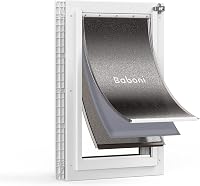
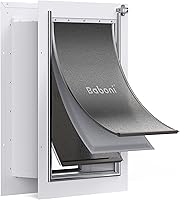
Choose the Baboni Medium when the medium passage fits your dog and you want a layered flap design. It has 2 vinyl flaps with magnetic closure and an insulated middle flap; Baboni says this arrangement helps limit drafts.
Its plastic frame includes a telescoping tunnel, a cutout template and installation instructions. Resolve the thickness requirement before ordering because Baboni gives conflicting compatibility figures.
The stated tunnel range is 1 3/8 to 1 31/32 in, while another specification gives only 1.38 in. Confirm which range applies to this exact model and your measured door.
Skip this option if you need more body clearance than the medium PetSafe allows. Their openings are too similar for the Baboni to solve a meaningful size problem.
Also consider your pet’s willingness to push through layered flaps. Allow extra time for a cautious dog to learn the movement rather than assuming the opening dimensions settle every use concern.
What should you check at the installation spot?
Check door thickness, flat mounting space and access on both sides before committing to a model. These can rule out an otherwise suitable pet opening.
Measure the door itself rather than including raised trim in the thickness measurement. Check where the frame will actually sit, especially on a paneled door with changes in surface depth.
Use this pre-cut checklist:
- Confirm the door material and thickness match the model’s instructions.
- Mark the full frame outline as well as the cutout.
- Check clearance from trim, locks, hinges and panel edges.
- Leave room to attach and remove any closing panel.
- Check that the human door can still swing freely.
- Keep the approach and landing clear on both sides.
Do not assume a hinged-door model also fits a wall or glass panel. Those locations may need a different tunnel, mounting system or professional installation.
For the full process, read how to install a dog door. Finish the placement checks before picking up a cutting tool.
How do you help your dog use the new opening?
Start with short, calm practice sessions and an unobstructed approach. Give your dog time to learn where the opening leads before expecting independent trips outside.
Follow the model’s instructions for introducing the flap, and reward voluntary movement through the doorway. Never force your pet’s head or body through a closed flap.
Watch for a fit problem if your dog repeatedly catches a hip or belly at the same point. Reluctance can come from unfamiliarity, but rewards cannot fix an opening that is physically too small.
Check return trips as carefully as exits, especially where the outdoor ground sits lower. Keep mats, bowls and furniture away from the landing so your dog has room to step through.
Our guide to training a dog to use a dog door covers a gradual introduction. Continue supervising until your pet can pass comfortably in both directions.
What care helps keep the passage usable?
Keep the flap edges, threshold and closing surfaces clean so debris does not interfere with movement. Follow the model’s care instructions and check the opening regularly.
Wipe away mud and hair with a soft cloth and a suitable mild cleaner. Remove grit around the bottom edge rather than letting it collect where the flap closes.
Look for loose fasteners, damaged flap edges or a frame that has shifted. Correct alignment problems according to the instructions rather than trimming parts to make them move.
After painting a paintable frame, confirm that moving parts and the closing panel still work freely. Recheck your dog’s clearance as a puppy grows or an older pet changes how it walks.
Which sizing mistakes should you avoid?
Avoid choosing by weight alone, size labels or the dimensions of an old flap. Each can point you toward a door that fails either the pet-fit check or the installation check.
- Using breed averages: Measure your own dog because body shape varies within a breed.
- Confusing width with chest circumference: The opening needs straight-across body width, not the distance around the chest.
- Raising the door to gain headroom: Check the resulting step before accepting that placement.
- Cutting from passage dimensions: Only the correct cutting template defines the installation hole.
- Sizing for one pet: Measure every animal that needs access.
- Assuming a larger frame fixes an old hole: Verify the cutout and mounting requirements before replacing anything.
Another mistake is choosing a door for a puppy’s current body without a growth plan. Enlarging a permanent opening later can mean replacing the pet door and reworking the surrounding surface.
How should you use the dog door size chart to decide?
Use the dog door size chart to shortlist, then let comfortable movement and installation fit make the final choice. Reject any option that requires squeezing, an awkward step or a frame that cannot sit correctly.
Choose PetSafe Medium when its compact passage fits easily. Move to Large or X-Large only when your dog needs the added clearance and your human door has room for the assembly.
Choose Baboni Medium when that size fits and the layered flap design addresses your draft concerns. Confirm its door-thickness compatibility before buying.
If none fits both your pet and the installation spot, change the model or location before cutting. Our dog door types and buying guide can help you choose a different approach.
Frequently asked questions
How do I know what size dog door to buy?
Choose by your dog’s width, shoulder height and comfortable step-over height, then compare those measurements with the clear opening and mounting instructions; check the stated pet weight limit as an additional condition. Before buying, confirm that the frame, cutout and thickness range suit your door.
Should a dog door be bigger than my dog?
The opening needs clearance around your dog’s body so your pet can pass without squeezing or sharply crouching; there is no single extra allowance that suits every door and dog. Follow the model’s sizing instructions, check a measured mock opening, and avoid making a permanent cut based on weight alone.
Does dog weight determine dog door size?
Weight helps narrow your choices, but it cannot show body shape or comfortable clearance; dogs of the same weight can have different chest widths, shoulder heights and leg lengths. Choose an opening using actual measurements, then check that your dog also falls within the model’s stated weight guidance.
How do I measure my dog for a dog door?
Measure from the floor to the shoulders and across the widest part of the chest or hips while your dog stands naturally; also consider how high your dog can comfortably step. Use these measurements with the door’s mounting instructions, and account for adult size if your pet is still growing.
What is the difference between flap size and cutout size?
The flap opening is the passage your dog uses, while the cutout is the hole required to fit the door assembly; the outside frame covers more space around that hole. Use the exact model’s cutting template, and check clearance for the frame and closing panel before making any cuts.