Dog Doors Explained: Types, Sizes and What to Buy
Choose a dog door by your pet’s measurements, the mounting surface and your access needs. Check the clear opening, step-over height and installation dimensions before choosing weather features or electronic controls.
On this page (14 sections)
- What types of dog doors can you choose?
- How do you measure a dog door for your pet?
- Where should you install a dog door?
- Who should choose the Baboni door-mounted flap?
- When does the Baboni wall model make sense?
- Is the PetSafe sliding glass dog door a good fit?
- Who benefits from the PetSafe electronic dog door?
- Which dog door features matter for cold, wind and rain?
- How should you manage security and access?
- What should you check before making a cut or fitting a panel?
- How do you help a dog learn to use the opening?
- What care does a dog door need?
- What common buying mistakes should you avoid?
- Which dog door should you buy?
Choose a dog door that fits your dog comfortably, works with your home and gives you the access control you need. Decide where it can go before comparing flap layers, frame materials or electronic features.
A well-sized opening can still be the wrong buy if it leads onto slippery steps, narrows your only patio exit or needs a cut you cannot make. The route on both sides matters as much as the door itself.
This guide explains the main choices and where 4 specific models fit. For a broader product shortlist, see our best dog doors guide.
What types of dog doors can you choose?
The main choices are door-mounted flaps, wall-mounted doors, sliding glass inserts and electronic doors. The first 3 describe where the door fits; electronic describes how access is controlled.
That distinction matters because an electronic model still needs a suitable mounting location. It does not remove the need to measure the opening, check the surface or plan the installation.
| Type | Best starting situation | Main trade-off |
|---|---|---|
| Door-mounted flap | You have a suitable door on the right route | Requires a permanent cut in that door |
| Wall-mounted door | The best pet route goes through a wall | Needs a clear wall cavity and a correctly fitted tunnel |
| Sliding glass insert | You want a route through an existing slider without cutting | Reduces the space people have to walk through |
| Electronic door | You need access tied to a compatible pet key | Adds power, programming and key care |
A standard flap lets an animal push through without identifying it. That makes daily use simple, but it also means another pet or animal may be able to use the opening.
An electronic door adds a way to control passage. Choose it because you need that control, rather than assuming electronic operation makes every part of the door better.
How do you measure a dog door for your pet?
Measure chest width, shoulder height and a comfortable step-over, then compare them with the clear flap opening and its planned position. A pet weight limit is a screening tool, not a fit measurement.
Have your dog stand naturally on level ground. Measure the widest part of the chest without pressing the coat flat, then measure from the floor to the top of the shoulders.
Use those numbers together with the maker’s mounting guidance. The top of the opening needs to sit high enough for comfortable passage, while the bottom must remain easy to step over.
Allow room for normal movement rather than choosing an opening that exactly matches chest width. A dog moving at an angle, carrying a toy or wearing a harness may need more space than a still measurement suggests.
For a shared door, measure the broadest and tallest pet as well as the smallest. A position that suits a tall dog can leave a smaller companion facing an awkward step.
You can make a rough opening in a large piece of cardboard and hold it steady at the planned height. Let your dog approach it voluntarily to assess the space, but remember that cardboard does not reproduce flap resistance or tunnel depth.
Use our dog door size chart for more help comparing your pet’s shape with the opening.
What does a dog door size label tell you?
A size label helps narrow the choices, but the opening dimensions decide fit. Dogs with the same weight can have very different chest widths, leg lengths and body shapes.
The 4 models discussed here are Large versions described for pets up to 100 lb. That shared limit does not make them interchangeable or mean every dog below it will pass comfortably.
Keep these 3 measurements separate:
- Flap opening: the space your pet moves through.
- Frame size: the area the finished unit covers.
- Cutout size: the hole required in the door or wall.
A replacement frame may cover an old opening without fitting it correctly. Check the cutout, mounting points and surface thickness before treating any new model as a direct replacement.
Where should you install a dog door?
Choose the location with a clear indoor approach and a safe outdoor landing. Then check whether the door, wall or sliding track can accept the model you want.
Inside, leave room for your dog to approach without weaving around furniture. Avoid a position where a swinging room door, storage box or food bowl blocks the path.
Outside, check the ground at the exit rather than judging the route from indoors. A steep drop, slick surface or narrow landing can make a correctly sized opening hard to use.
Think about rain runoff and mud as well. A sheltered exit with firm footing can be more useful than a shorter route that sends your dog straight into a puddle.
For a door mount, check the door’s construction, lower panels and hardware before planning the cut. Do not assume an interior hollow-core door, metal exterior door and glazed door can use the same installation method.
A wall route needs checks for pipes, wires and structural parts. Its tunnel must span the finished wall depth, including the interior and exterior finishes.
If you are weighing those 2 routes, read wall mount vs door mount dog doors. Our dog doors for walls and exterior doors guide helps narrow the models once the location is settled.
Who should choose the Baboni door-mounted flap?
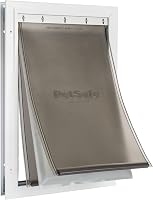
Choose the Baboni Plastic 3-Flap Dog Door, Large if you have a suitable door and want a manual flap with several weather layers. Skip it if you need selective pet access or cannot make a permanent cut.
Its flap opening is 10 1/4 x 16 1/4 in. The plastic frame measures 14 1/4 x 21 1/16 in, and the required door cutout is 11 2/5 x 19 3/8 in.
The telescoping tunnel accommodates doors from 1 3/8 to 1 31/32 in thick. Measure your actual door at the proposed opening instead of assuming it matches a common thickness.
The flap assembly has 2 vinyl flaps with magnetic closure and an insulated middle flap. Baboni describes this design as helping reduce drafts and improve insulation.
This model suits a home where all pets allowed near the opening may use the same route. Its magnetic closure helps the flap settle shut; it does not identify which animal is passing through.
A cutout template and installation instructions are included. Use the template for this exact model, and check the frame’s position on both sides before cutting.
For a cautious dog, allow time to learn the flap layers. Do not choose a tight opening on the assumption that the dog will get used to squeezing through.
When does the Baboni wall model make sense?
Choose the Baboni Telescoping Wall Pet Door, Large when a wall gives your dog the most useful route and its depth fits the tunnel. Skip it if the wall cavity or outside landing cannot support the installation.
The tunnel accommodates walls from 4 3/4 to 7 1/4 in thick. Measure the complete wall assembly, rather than just the framing or the depth visible at an unfinished opening.
This model uses a metal frame, a 3-flap design and a metal closing panel. Baboni describes the flap layers as helping limit drafts and maintain indoor comfort.
The frame measures 14 1/4 x 21 1/16 in, while the wall cutout is 12 x 17 3/4 in. Its cutout differs from the door-mounted Baboni model, so sharing a flap size does not mean sharing a template.
A wall installation can preserve the existing human doorway and place the pet route away from busy foot traffic. That benefit is strongest when the wall exit leads to a level, usable area.
The closing panel gives you a way to block pet passage when needed. Keep it accessible so closing the route becomes part of your evening or bad-weather routine.
A template cannot tell you what is hidden inside a wall. Have the location assessed before cutting, especially when you cannot confidently identify the construction and services.
Is the PetSafe sliding glass dog door a good fit?
Choose the PetSafe Sliding Glass Dog Door, Large if you have a compatible slider and want to avoid cutting a door or wall. Skip it if the remaining human doorway would be too narrow or the track falls outside its height range.
This 1-piece panel adjusts from 75 7/8 to 80 11/16 in high. Measure at the track where it will sit, following the panel’s installation guidance.
The panel takes 13 1/2 in out of the human walk-through opening. Mark that width before ordering, then consider everyday trips through the doorway with groceries, laundry or outdoor furniture.
Its step-over height is 4 1/4 in. That deserves a separate check for short-legged dogs and pets that struggle with steps, even when the flap itself is wide enough.
The panel combines an aluminum frame, tempered glass and a magnetic flap. A closing panel, latch kit, glass sweep and weather stripping are included.
Fit affects both the pet route and the human door. Check how the slider meets the insert, how the latch secures it and whether gaps remain along the seals.
The assembled panel can be used for temporary or permanent installation and taken along when you move. Renters should still agree on any attachment or latch changes before fitting it.
Read our best dog doors for sliding glass doors guide if your track, doorway width or preferred installation needs a different option.
Who benefits from the PetSafe electronic dog door?
Choose the PetSafe Electronic Pet Door, Collar Key Large when programmable access solves a daily household problem. Skip it if you want a simple flap and would rather avoid batteries, keys and programming.
It works with a waterproof Electronic Pet Door Key worn on the pet’s collar. The door detects a compatible key, permits passage in automatic mode and locks again after the pet passes.
The door offers programmable entry, exit and auto-locking options. Its detection range is adjustable up to 3 feet, so setup includes finding a useful response distance for the approach.
The door runs on 4 D-cell batteries, which are not included. It is designed for interior or exterior doors, with a separate Wall Install Kit available for wall mounting.
This model is worth considering when one pet needs outdoor access while another should stay inside. Before relying on that arrangement, observe how pets behave together near the opening.
A second animal following closely behind an authorized pet remains a practical concern. Selective access reduces reliance on an open flap, but it does not replace supervision where separation is essential.
Confirm this model’s clear opening and installation dimensions before ordering. Do not borrow dimensions from the manual PetSafe panel or either Baboni model.
For the broader choice, read electronic vs flap dog doors. Our best electronic dog doors guide covers more options if key-based access is your priority.
Which dog door features matter for cold, wind and rain?
Prioritize flap closure, frame sealing and exposure before treating the number of flap layers as the whole weather story. A well-positioned opening still needs careful installation and routine care.
Multiple flaps add barriers between indoor and outdoor air. Their value depends on whether the flaps hang correctly, close fully and remain free of grit or damage.
Wind can push against the flap, while dirt at the edges can leave small gaps. Check the finished opening from both sides after installation and again after windy weather.
The joint around the frame matters too. Follow the installation instructions for sealing the frame to the mounting surface, and keep any drainage paths clear.
A closing panel helps when you do not need pet access overnight or during bad weather. Make sure your dog has another way to reach its toilet area before shutting the route.
Consider traffic as well as climate. Frequent trips through any opening exchange indoor and outdoor air, so a quieter location and a sensible access routine can matter alongside flap design.
For a closer look at weather-focused choices, read best dog doors for cold weather.
How should you manage security and access?
Treat a dog door as an extra opening you need to manage. A flap magnet, closing panel, human-door latch and electronic key each serve a different purpose.
A magnet helps a flap return to its closed position. It does not restrict passage to your own dog or prevent another animal from pushing through.
A closing panel blocks the pet route when fitted. Check how it attaches, where you will store it and whether you can use it easily every day.
A sliding-door latch secures the human slider in its new position beside an insert. Confirm that it engages properly after installation rather than assuming the original lock still works.
Look at the opening’s location from outside. Consider whether nearby door hardware or indoor belongings are within reach, and avoid leaving keys close to the pet entrance.
Outdoor access also needs a suitable enclosed area and secure gates. The pet door controls passage through the building; it does not keep a dog within the yard.
Decide when access should be open, restricted or closed before fitting the unit. For more detail on these controls, see dog door security: locks, covers and panels.
What should you check before making a cut or fitting a panel?
Finish all measurements and compatibility checks before installation. The delivered unit and its own instructions should guide the final layout.
Check that the model, size and included parts match what you planned. Compare its template with the available surface, leaving room for the frame, fasteners and any closing panel.
For a cut-in model, mark the opening and check it from both sides. Door trim, raised panels, exterior steps and interior skirting can affect a position that looks clear from one side.
Confirm the mounting height using your dog’s needs before committing to the hole. A correctly shaped cutout in the wrong place is still a poor installation.
For a sliding insert, clean the track and inspect its condition first. Fit the panel squarely, then check the human door’s movement, latch and seals.
After installation, check for exposed sharp edges, loose fixings and gaps. Operate any closing panel or lock before giving your dog routine access.
Read how to install a dog door or how to install a dog door in a wall for the next steps. Use a qualified installer when the door construction, wall cavity or sealing work is beyond your skills.
In a rental, settle approval and repair expectations before cutting or attaching hardware. A removable product can still leave screw holes or require changes to a latch.
How do you help a dog learn to use the opening?
Teach the route slowly and with short, calm practice sessions. Let the dog choose to approach rather than pushing it through the flap.
Start with the area clear on both sides. If the instructions allow it, hold the flap open at first so your dog can see the exit and move through without flap pressure.
Reward a calm approach, then a step through, and gradually introduce normal flap movement. Practice in both directions because returning indoors may feel different from going out.
Work with one pet at a time in a multi-pet home. A confident dog rushing through can make a cautious companion back away or hide a fit problem.
For an electronic door, let the dog become familiar with its movement and sound while you supervise. Check that the key position and settings allow comfortable passage before leaving access on.
Stop if your dog repeatedly catches a shoulder, scrapes its back or struggles with the step. Recheck fit and mounting height instead of treating every hesitation as a training issue.
Our guide to training a dog to use a dog door explains how to build confidence without forcing progress.
What care does a dog door need?
Keep flaps, seals, tracks and controls clean and working freely. A short routine check can catch a problem before it stops the flap from closing or makes passage awkward.
Wipe away mud, hair and grit using a method suitable for the materials. Avoid harsh cleaners or tools that could damage flexible flaps, seals or clear surfaces.
Watch the flap after your dog passes through. It should settle into its intended position without catching on the frame or remaining folded back.
Inspect fixings and the surrounding surface for movement or water marks. Repeated looseness or dampness calls for attention to the installation, rather than simply tightening the same screw again.
Clear debris from a sliding-door track and keep the closing panel’s guides usable. Store removable panels where they will stay clean and easy to find.
For an electronic model, follow its battery and key-care instructions. Recheck normal operation after changing batteries or settings, and arrange pet access before taking the door out of service.
If a flap splits, curls or no longer hangs correctly, choose a compatible replacement. Our dog door replacement flap guide explains what to measure before replacing that part.
What common buying mistakes should you avoid?
The biggest mistakes are choosing by weight alone, measuring the wrong opening and overlooking the human doorway. These errors can rule out an otherwise suitable model.
- Buying the size name: compare your dog with the clear opening and planned mounting height.
- Using frame size as passage space: the visible frame is larger than the route your pet uses.
- Sharing templates between models: matching flap dimensions do not mean matching cutouts.
- Ignoring the finished wall depth: the tunnel must span the full wall assembly.
- Forgetting the step-over: a wide opening can still be awkward to enter.
- Assuming no-cut means no setup: sliding inserts still need correct seals and a working latch.
- Choosing electronics without an access plan: decide which pets may pass and when.
- Cutting before checking both sides: trim, hardware and outdoor footing can change the best position.
Avoid buying extra features to solve the wrong problem. More flap layers cannot fix a poorly placed exit, and programmable access cannot make an undersized opening comfortable.
Which dog door should you buy?
Choose your dog door by eliminating poor fits first, then selecting the controls your household will use. The best choice is the one that works for your dog, the building and your daily routine.
| Choose this model | If this describes your home | Choose another route if |
|---|---|---|
| Baboni Plastic 3-Flap Dog Door, Large | A suitable door leads to the right outdoor area, and manual passage meets your needs | You cannot cut the door or need selective access |
| Baboni Telescoping Wall Pet Door, Large | A suitable wall gives the best route and fits the tunnel | Hidden services, wall depth or the landing rule out that position |
| PetSafe Sliding Glass Dog Door, Large | Your slider fits the panel and leaves enough room for people | The remaining walkway or step-over is unsuitable |
| PetSafe Electronic Pet Door, Collar Key Large | Key-based access solves a clear household need | You want fewer controls or cannot manage keys and power |
Before ordering, write down your pet measurements, the mounting dimensions and the access routine you want. That gives you a simple way to reject a poor match before making a permanent change.
Use the dog door size chart if fit is still uncertain. Once the measurements and location work, compare the wider shortlist in best dog doors.
Frequently asked questions
How do I choose the right size dog door?
Choose a dog door by clear opening size and mounting height, using your dog’s chest width and shoulder height as guides. Your pet should pass without squeezing or a deep crouch; check the step-over too, and measure every pet that will share the opening rather than relying on a weight limit.
Are wall dog doors better than door-mounted dog doors?
A wall dog door is better when it creates a safer, more useful route outside than an existing door. It needs a tunnel that fits the finished wall depth and a clear path through the wall; a door-mounted model is often a simpler choice when the door construction and thickness suit it.
Can a dog door keep cold air out?
Multiple flaps, magnetic closures and a well-fitted frame can help reduce drafts, but a pet opening still lets air move during use. Choose around wind exposure and how often your dog goes through; keep flap edges clean, check their alignment and close the opening when pet access is not needed.
Are electronic dog doors worth it?
Electronic dog doors are worth considering when selective pet access solves a daily problem, such as giving one dog outdoor access while restricting another pet. Collar-key models need compatible keys, power and correct programming; choose a standard flap if every pet may use the same route and you want fewer controls to manage.
Can renters install a dog door?
Renters can consider a dog door after checking the lease and getting any required approval. Cutting a door or wall creates a change that must be agreed on in advance; a removable sliding glass insert avoids that cut, but its latch arrangement, seals and effect on the human doorway still need checking.