Dog Door in Wall vs Door: Which Is Better? (November 2026)
For a dog door in wall vs door choice, choose a wall mount for a better yard access point or a door mount when an existing door gives your dog a safe, convenient route. Confirm your dog's measurements and the surface's construction before cutting.
On this page (9 sections)
- Dog door in wall vs door: which fits your home?
- Which of these three dog doors suits your project?
- Which installation is more involved?
- How do you know if the opening fits your dog?
- Do extra flaps make a wall or door mount warmer?
- Which setup is easier to secure?
- How should you introduce and maintain the new opening?
- What mistakes should you avoid before cutting?
- Which should you choose?
Choose a wall mount when it gives your dog a better route outside; choose a door mount when a suitable existing door already leads to the right place. For a dog door in wall vs door decision, start with location and construction before comparing flap layers.
A wall mount gives you more choice about where your dog exits, but the tunnel must cross the whole wall. A door mount keeps the opening in an existing doorway, where the door's panels, thickness and swing can limit placement.
Both involve a permanent cut. The best choice is the one that fits your dog, reaches a safe outdoor area and can be installed and closed properly.
 Best for busy household doorways
Baboni Telescoping Wall Pet Door, Large

Dog door in wall vs door: which fits your home?
Choose the mount that creates a clear, usable route on both sides of the opening. A convenient indoor spot is a poor choice if your dog steps out onto stairs, loose ground or an area outside the enclosed yard.
Walk the route from your dog's usual resting area to the proposed exit. Check for furniture, narrow passages and household traffic that could make the opening awkward to reach.
Outside, look for a stable landing with room to turn around. Consider where rain collects and whether plants or stored items could block the approach.
If you need help weighing styles, start with the types of dog doors and what to buy. For more options suited to these surfaces, see dog doors for walls and exterior doors.
When does a wall-mounted dog door beat a door mount?
A wall mount works best when it gives your dog a separate path away from a busy household doorway. It also suits rooms beside the yard that have no useful exterior door.
You can leave the people door intact and position the pet route elsewhere along a suitable wall. That flexibility matters when the existing doorway opens onto steps or a narrow landing.
Skip a wall mount if the proposed spot contains utilities, lacks room between structural members or would need major changes to create a safe exit. A short indoor route does not justify a poor outdoor landing.
When is an existing door the better location?
A door mount makes sense when your dog already uses that doorway and both sides offer enough clearance. It can keep departures, paw wiping and pet supplies together in one area.
Check the door in its open and closed positions. The pet frame must clear nearby objects, and someone opening the door should not swing it into a dog approaching the flap.
Skip this route if the only available position crosses unsuitable panels, sits too high for your pet or leaves too little room for the full frame. Glass, special door assemblies and uncertain construction need a suitable installation plan.
Which of these three dog doors suits your project?
Choose the mounting location first, then select the model that fits that surface. These products solve different installation needs, so a higher score does not make a door model suitable for a wall.
Baboni wall model: for a separate pet route
The Baboni Telescoping Wall Pet Door suits households that want pet traffic away from the main doorway. It has three flaps and includes a metal closing panel for controlling access.
Its tunnel fits walls 4 3/4–7 1/4 in thick. Measure the complete finished wall, including its interior and exterior layers, before deciding that the tunnel will span it.
Skip this model if your wall falls outside that range or the location needs a different opening size. Do not plan to bridge an unsupported gap with sealant or improvised pieces.
Baboni door model: for your dog's usual exit
The Baboni Plastic 3-Flap Dog Door suits a suitable exterior door already on your dog's daily route. It uses two vinyl flaps with magnetic closure and an insulated middle flap.
Confirm thickness compatibility with Baboni before ordering. Its thickness guidance conflicts: the installation details give 1 3/8–1 31/32 in, while another specification gives 1 in.
Skip it until that point is resolved for your measured door. A frame that cannot clamp and seal correctly is the wrong fit, even when your dog fits through the flap.
PetSafe wall model: for projects needing tunnel extensions
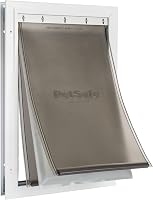
The PetSafe Wall Entry Pet Door is the option here to consider when a deeper wall needs a compatible extension kit. Its standard tunnel covers the same wall range as the Baboni wall model, with extensions sold separately.
It has a plastic frame, two flaps and a slide-in closing panel. The frame offers an alternative for buyers who want to avoid a steel frame that could rust.
Skip it if you cannot confirm the extension combination for your finished wall depth. Extra tunnel length also does not remove the need for a clear, sound installation location.
Which installation is more involved?
A wall installation generally has more layers and hidden obstacles to assess than a cutout in a suitable plain door. Door construction can still make a project complex, so judge the actual surface rather than assuming either job is simple.
For wall work, check both faces and the full path between them for wiring, plumbing and structural members. A clear patch of drywall does not prove that the space behind it is clear.
Plan how the tunnel, exterior frame and surrounding wall will shed water. Follow the model's sealing instructions, since a weather-resistant flap cannot protect a poorly sealed cutout.
For a door mount, identify the door material and any restrictions on cutting it. Do not assume a template makes glass, a fire-rated assembly or a heavily paneled door suitable for a general-purpose installation.
Plan the cut and future repairs
Use the template for the exact model, and distinguish the flap opening from the cutout and outside frame dimensions. These measurements serve different purposes and are not interchangeable.
Mark the proposed position before cutting and check that the frame has room to sit flat. Include space to insert and remove any closing panel without hitting trim, furniture or a nearby wall.
Think about removal, too. A door installation may mean replacing the door later, while a wall installation can require repairs to the inner finish, outer finish and materials between them.
Renters need written permission for permanent alterations; see putting a dog door in a rental home before choosing a location. If construction is uncertain, have a qualified installer assess it before you buy.
Read how to install a dog door in a wall for wall-specific steps. For more wall options, use the wall dog door guide.
How do you know if the opening fits your dog?
Choose by body measurements and step-over height, not weight alone. A dog can fall within a model's weight guidance yet be too broad or tall for comfortable passage.
All three large models here have a 10 1/4 x 16 1/4 in flap opening and are intended for pets up to 100 lb. That shared opening lets you compare mounting needs without assuming one provides more pet clearance.
Measure your dog's widest point and use the brand's sizing method for height. Then check the proposed bottom edge of the opening against the finished indoor floor and outdoor landing.
A comfortable height indoors may leave a large drop outside. Smaller pets sharing the opening also need to cross the threshold without climbing or jumping awkwardly.
For a wall mount, allow for the tunnel as well as the visible flap. Your dog needs to approach straight enough to pass through without twisting around nearby furniture.
Use the dog door size chart to work out the opening your pet needs. If the fit is close, keep comparing sizes before making a permanent cut.
Do extra flaps make a wall or door mount warmer?
Extra flaps add barriers, but the installed seal and exposure also matter. Neither mounting style is automatically warmer simply because it goes through a wall or a door.
Baboni describes its three-flap designs as helping reduce drafts, and PetSafe describes its double flap as providing weather protection. Those designs do not tell you which will perform better in your particular location.
Look at how wind and rain reach the proposed opening. A sheltered position can reduce direct exposure, provided it still gives your dog a safe and practical route.
The frame perimeter, tunnel joints and moving flaps all need attention. Air can pass around an installation even when the flap itself closes properly.
For colder locations, compare dog doors for cold weather. Include access controls in the plan with dog door security options, especially when you want the opening closed overnight.
Which setup is easier to secure?
Choose a location where you can control pet access and limit outside reach. A wall mount can be too close to a household lock, and a door mount can expose the same problem.
Look from outside at what someone could reach through the proposed opening. Include nearby locks, keys and controls, rather than judging only the distance to the main door handle.
A closing panel helps stop pet traffic, but it does not by itself guarantee resistance to forced entry. Magnetic flap closures also do not identify which animal is entering.
Decide when access should stop, such as during yard work, deliveries or an open gate. Everyone in the household should know how to close the opening and check that it is secured.
Our guide to dog door locks, covers and panels explains access-control options. For the broader location decision, read are dog doors safe for your home?.
How should you introduce and maintain the new opening?
Introduce the route gradually, then keep the flaps, tunnel and landing clear. A correctly sized opening still takes some dogs time to accept.
Begin with supervised approaches and rewards for calm movement toward the opening. Follow the model's guidance for holding flaps open during early sessions, and never push a reluctant dog through.
Practice both directions because the light, view and landing can feel different. For a moving household door, keep it still during practice so the opening does not shift as the dog approaches.
Use the dog door training guide if your pet hesitates. Start with short sessions and watch for trouble with the step-over height or tunnel rather than treating all hesitation as a training issue.
Keep the closing path clear
Remove fur, grit and mud that stop the flap from returning to its normal position. Clean with methods allowed by the brand, avoiding harsh products that could damage flexible parts.
Check that each flap hangs straight and meets its closing edge. After strong wind or heavy use, look for trapped debris, loose fasteners or a frame that has shifted.
Inspect the wall tunnel for collected dirt and check the outside landing for standing water. Keep the closing panel's path clear so you can shut access when needed.
What mistakes should you avoid before cutting?
The biggest mistakes are choosing by weight alone, using the wrong dimensions and ignoring the outside landing. Catching them on paper is easier than correcting a finished hole.
Do not transfer a cutout from another model, even if both have the same flap opening. Use the exact template and check its orientation against the instructions.
Avoid placing the opening solely to suit the room's furniture layout. Furniture can move, but a tunnel through a wall is a lasting change.
Do not buy a model whose thickness range almost fits and hope the frame will stretch farther. Confirm the door model's conflicting guidance or the wall model's extension needs before committing.
Finally, leave room for daily use and care. An opening hidden behind storage can become hard to clean, inspect or close when access needs to stop quickly.
Which should you choose?
For your dog door in wall vs door decision, choose a wall mount when it creates a better yard route and the wall can accept the installation. Choose a door mount when the existing exit already works and its construction permits the cut.
Pick the Baboni wall model for a separate pet route with three flaps. Consider the PetSafe wall model when your project needs its compatible extension system, after confirming the full tunnel setup.
Choose the Baboni door model when keeping the pet route in the existing doorway makes more sense, once its thickness fit is confirmed. If none fits your dog or surface, change the model or location before changing your home.
Your next step is to mark the proposed opening and check both approaches with your dog nearby. Then compare dog doors for walls and exterior doors against those measurements.
Frequently asked questions
Is a dog door in a wall better than one in a door?
A wall dog door is better when it creates a safer or shorter route to the yard, while a door mount suits an existing exit in the right location. Choose by the route, surface construction and pet fit first, then compare flap design and access controls.
Can you install a wall dog door in any wall?
No, a wall must have a suitable clear opening, compatible thickness and a way to seal the installation against weather; check for wiring, plumbing and structural obstructions before cutting. A deeper tunnel does not solve every wall problem, so get qualified help when the construction is uncertain.
Are wall and door dog doors the same size?
They can share a flap opening without sharing a cutout size or tunnel depth; all three large models here have a 10 1/4 x 16 1/4 in opening, but each needs its own installation template. Never use the old hole or another model's frame dimensions as your cutting guide.
Does a three-flap dog door keep out more drafts?
An extra flap adds another barrier, but flap count alone cannot rank draft control; Baboni describes its three-flap designs as helping reduce drafts, while PetSafe uses a double flap for weather protection. Frame sealing, flap alignment, wind exposure and wear also affect how well an installed opening closes.