Dog Door vs Cat Door: Can One Fit Both Pets? (November 2026)
For a dog door vs cat door, choose by physical fit and access needs. A dog door can serve both pets, while a compact cat door suits only animals that fit comfortably and meet any microchip requirements.
On this page (12 sections)
- Dog Door vs Cat Door: Can One Fit Both Pets?
- Dog door vs cat door: which opening fits both pets?
- Can a small dog use a cat door?
- Will a cat use a large dog flap?
- Does one shared door give both pets the same access?
- Which shared door suits your household?
- What should you measure before installation?
- How should you introduce both pets to the door?
- What care does a shared pet door need?
- What if the dog and cat need different access?
- Which mistakes should you avoid before buying?
- Which should you choose for a dog door vs cat door?
Dog Door vs Cat Door: Can One Fit Both Pets?
A dog door can serve both pets when the opening, flap and step-over height suit each animal. In a dog door vs cat door comparison, choose by fit and access needs rather than the animal pictured on the package.
A compact cat door may suit a small dog, while a large dog flap may work for a cat. Neither choice solves different access rules unless the door's controls and your home layout support them.
Start with 3 checks: which pets must pass, which pets may go outside and where the door will sit. Those answers narrow the choice before you make a permanent cut.

Dog door vs cat door: which opening fits both pets?
Choose the smallest opening that comfortably fits every intended user, following the model's sizing instructions. A shared door must accommodate the larger animal without creating an awkward climb for the smaller one.
The 2 large dog doors here offer much taller openings than the compact Cat Mate. Their similar opening sizes make flap design and access controls more useful deciding factors.
Weight limits help narrow your options, but they aren't a sizing method. A broad chest, deep body or long legs can change how a pet passes through an opening.
How should you compare dog door and cat door fit?
Measure each pet separately, then check the opening at its planned height. Record the widest body point and shoulder height while the animal stands naturally.
Use those measurements with the manufacturer's sizing directions rather than adding an arbitrary amount of clearance. The frame's outside dimensions aren't the usable passage.
A removable outline can help you picture the position before cutting. Don't force either pet through a makeshift opening to prove it fits.
Our guide to dog door sizes explains how to compare openings with pet measurements. For compact alternatives and access controls, see cat doors and their access features.
Can a small dog use a cat door?
A small dog can use a cat door when it fits comfortably and can operate the flap. The Cat Mate 360 is intended for small dogs as well as small to medium cats.
Skip a compact opening if your dog must squeeze its chest through, scrape its back or twist to pass. A pet that can barely get through today leaves little room for body changes.
For a puppy, plan around expected adult size rather than choosing only for its current body. Replacing a small door later may require another cut and a larger frame area.
With a microchip flap, check access compatibility as a separate step. For a broader overview of styles and sizing, read dog doors explained.
Will a cat use a large dog flap?
A cat may use a large dog flap, but flap resistance and step-over height matter as much as space. A roomy opening doesn't help if the cat won't push through it.
A shared installation should avoid making the smaller pet jump through a doorway placed mainly for the dog. Check the approach from both sides, including changes in floor or ground level.
Several flap layers also mean several surfaces for a pet to push past. Allow extra introduction time rather than assuming the cat will follow the dog immediately.
Watch for crowding around the opening. A cat may avoid a usable door if the dog waits on the other side or rushes through behind it.
Does one shared door give both pets the same access?
An ordinary shared flap gives both pets access while the opening is available. It can't distinguish the dog from the cat or a visiting animal that fits.
A closing panel blocks the passage for everyone. That works when both pets follow the same schedule, but it won't let the dog out while keeping the cat inside.
Microchip recognition addresses a different need: selective entry. The Cat Mate can recognize compatible chips, but that should not be read as individual control over which pet leaves.
Write down the desired rule in each direction before buying. “Let registered pets in” and “keep one household pet indoors” are different jobs.
Which shared door suits your household?
Choose Baboni for a layered weather barrier, Cat Mate for selective entry, or PetSafe for a basic shared passage. Each fits a different routine, so match the door to how your pets should use it.
Baboni: for pets sharing an exterior doorway
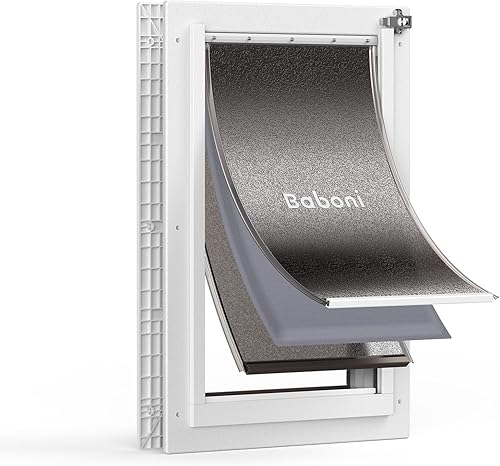
The Baboni suits households where a larger dog and cat need the same route outside. Its 2 vinyl flaps have magnetic closures, with an insulated middle flap between them.
It's designed for pets up to 100 lb and requires an 11 2/5 x 19 3/8 in cutout. Baboni describes the layered design as helping reduce drafts and heat transfer.
Skip it if you need automatic pet identification or either animal struggles with flap layers. It makes more sense for shared access than for separating your pets' movements.
Confirm the compatible door thickness with Baboni before cutting because its published figures conflict. Resolve that measurement before committing to the cutout.
Cat Mate: for controlling which pets enter
The Cat Mate suits smaller pets when unfamiliar cats entering the home are the main concern. A supported implanted microchip removes the need for a separate collar key.
It has a four-way rotary lock and self-lines to 85 mm. It doesn't support 10-digit microchips or chips containing letters, so check every intended user's chip before installation.
The door uses 4 AA batteries, which aren't included. Include battery care in your routine rather than treating it like an ordinary flap.
Skip this model for a larger dog or when your main goal is keeping one pet from leaving. Its compact passage and selective entry address different needs from a large shared dog door.
PetSafe: for a straightforward shared flap
The PetSafe suits a dog and cat that can share the same access schedule. Its snap-on panel lets you close the opening when neither pet should use it.
It fits interior or exterior wood, PVC, metal and paneled doors from 1/16 to 2 in thick. The paintable plastic frame helps you match the surrounding door.
It's designed for pets up to 100 lb, subject to comfortable physical fit. Choose it when basic passage and manual closure cover your needs.
Skip it if you want the door to identify pets automatically. Store the closing panel somewhere easy to reach so closing access remains part of your daily routine.
What should you measure before installation?
Measure the pets, mounting surface and surrounding space before choosing a cutout location. A suitable flap can still fail to fit the door or leave too little room for its frame.
Check the door's material and thickness at the proposed opening. Raised panels, trim and nearby hardware can affect where the frame sits flat.
Use the chosen model's template rather than transferring measurements from another brand. Flap opening, cutout size and outer frame size describe 3 different things.
Mark the full frame area on both sides with removable tape. Open and close the human door to check clearance against walls, steps and nearby furniture.
Examine the outdoor landing too. Loose objects, a steep drop or a cramped approach can make an otherwise suitable pet door difficult to use.
For a standard installation, follow how to install a dog door. If the larger pet drives your choice, see dog doors for large dogs.
How should you introduce both pets to the door?
Introduce one pet at a time in short, calm sessions. Let each animal approach and inspect the opening before asking it to pass through.
If the manufacturer's directions allow it, begin with the flap held clear so the pet can see the route. Use a familiar reward on the other side without pulling or pushing the animal through.
Gradually introduce contact with the flap once passing through the opening feels routine. Keep the other pet away during early sessions so there is no rushing or blocking.
For a microchip door, register each intended pet and confirm entry works before depending on it. Make sure the pet can enter from outside, rather than assuming a saved chip means the whole routine is ready.
Keep supervised access available while both animals learn. Our guide to training a dog to use a dog door covers a gradual introduction.
What care does a shared pet door need?
Keep the passage clear and the flap moving freely so both pets can use it without extra resistance. Hair, mud and grit can collect around edges and closures.
Inspect both sides regularly and clean them according to the manufacturer's care directions. Avoid adding cleaners or lubricants to electronic parts unless the instructions permit them.
Check that the frame remains secure and that flap edges return to their normal position. A flap catching on its frame deserves attention before it becomes part of your pet's daily route.
For the Cat Mate, follow the battery instructions and check operation after changing batteries. Keep the contacts dry during cleaning.
Also check any panel or lock you rely on at night. Our dog door security guide explains how covers and locks fit into an access plan.
What if the dog and cat need different access?
Use separate, controlled routes or supervised access when the pets need different rules. A shared opening is a poor match for a dog allowed outside and an indoor-only cat.
A smaller cat can often reach a large dog flap, so adding a second cat door doesn't create separation by itself. The home layout must also control which opening each pet can reach.
An interior door or separate room may help manage routes, provided each animal has the space and resources it needs. Plan the full path through the home before adding another cutout.
An interior cat flap can also give a cat access to a room a larger dog can't enter. That approach depends on actual body sizes and won't exclude a dog small enough to follow.
Which mistakes should you avoid before buying?
Avoid choosing by the product name or pet weight alone. The usable opening, mounting height and access controls decide whether a door fits your household.
Don't enlarge an existing cutout until you've checked the new frame's dimensions and screw locations. A bigger flap doesn't guarantee that its frame will cover the old opening.
Don't choose extra flap layers solely for weather protection if a timid pet won't push through them. Balance the barrier you want with the animals' ability to use it.
Don't assume a pet door replaces a secure outdoor area. Check gates, fencing and the space beyond the opening before allowing independent access.
Finally, don't remove your usual supervised routine on installation day. Both pets should be comfortable entering and leaving before you rely on the new route.
Which should you choose for a dog door vs cat door?
Choose Baboni when both pets need a larger shared opening and you want its layered weather barrier. Choose PetSafe when an ordinary shared flap and manual closing panel fit your routine.
Choose Cat Mate when the intended pets fit a compact passage and selective microchip entry solves your main problem. Confirm chip compatibility before buying, especially if a small dog will share it.
If the dog may go out but the cat must stay inside, settle the access plan before choosing any of these doors. Physical fit alone won't solve that household rule.
Your next step in choosing a dog door vs cat door is to record both pets' measurements and the proposed mounting height. Use the dog door size chart to check that plan before making a permanent opening.
Frequently asked questions
Can a dog door work for a cat?
Yes, a dog door can work for a cat if the cat fits comfortably and can push through the flap; check the step-over height as well as the opening dimensions, especially when a larger dog determines the installation height. Introduce each pet separately so one doesn't crowd the other.
Can a cat door work for a dog?
A cat door can work for a small dog whose body fits without squeezing or scraping; the Cat Mate 360 is intended for small dogs as well as small to medium cats. For a microchip model, check the dog's chip compatibility too, since physical fit alone doesn't ensure entry.
Should a dog and cat share one pet door?
They can share one door when both fit, can use the flap and should have the same outdoor access; choose separate routes or managed access when their routines differ. Selective microchip entry doesn't automatically stop an indoor-only cat from leaving through an opening available to the dog.
How do you measure for a shared dog and cat door?
Measure each pet's widest body point and shoulder height while standing naturally, then follow the chosen door's sizing instructions; include the planned step-over height when checking clearance. Measure door thickness, frame space and cutout area separately, because a flap that fits both animals can still be unsuitable for your door.