Are Dog Doors Safe for Your Home?
Dog doors can be safe with a comfortable fit, controlled access, and a secure outdoor area. Check reach to nearby locks, outside hazards, and how you'll close the opening when access isn't needed.
On this page (6 sections)
Dog doors can be safe when your dog fits comfortably, the yard is secure, and you can control access. The opening, its position, and your daily routine matter more than choosing a flap or electronic model alone.
Before buying, check 3 things: where the opening leads, whether it exposes a nearby lock, and how you'll close it. If you're still choosing a type, our guide to dog doors explains the main options.
Are dog doors safe for home security?
A dog door creates a security risk when someone can reach door hardware or fit through the opening. Assess the position from outside before deciding where to cut.
Check nearby handles, thumb-turn locks, and windows, including whether someone could reach them with an object. A location hidden from the street still needs the same checks.
Choose the smallest opening that lets your dog pass comfortably. Don't squeeze your dog through an undersized flap to reduce security risk; choose another location or skip the installation if the required opening is unsuitable.
A closing panel blocks routine passage, but its strength and attachment matter. A collar sensor controls pet access; it doesn't make the surrounding door resistant to forced entry.
Our guide to dog door security, locks, covers, and panels explains closure options. If you can't secure the opening when you're away, arrange supervised outdoor breaks instead.
Are dog doors safe from other animals?
A standard flap cannot tell your pet from another animal. Stray cats and wildlife can use an accessible opening, particularly when food attracts them.
Keep bowls, treats, and trash away from the approach. Close the door during periods of unwanted animal activity; our guide to whether dog doors let other animals in covers this risk further.
The PetSafe Electronic Pet Door, Collar Key Large suits households that need selective entry and exit. It supports up to 5 collar keys and offers programmable access and automatic locking.
Its waterproof collar key triggers access in automatic mode, with an adjustable detection range up to 3 ft. The door uses 4 D-cell batteries, which aren't included.
Skip this model if your pet won't wear a collar key or you won't maintain batteries. Allow space for the dog to approach and pass through, and watch for another animal following closely behind.
Are dog doors safe for pets?
A dog door is safer when your pet can walk through calmly without squeezing or catching its body. Measure your dog's width and height, then compare those measurements with the usable opening.
Body weight and a Large label aren't enough to confirm fit. Use our dog door size chart to work out the opening and step-over height your dog needs.
Check the smallest pet in a shared household as well as the largest. A high threshold that one dog clears easily may be difficult for a short-legged or older companion.
Can a dog door cause a fall or injury?
Yes, a poor landing or awkward approach can create slip, collision, and fall risks. Both sides need a stable surface with enough room for your dog to stop and turn.
Avoid openings that lead straight onto stairs, a sharp drop, or a driveway. Walk the full route to the yard and check gates, fence gaps, pools, and access to roads.
Practice with the door secured open as the instructions allow, then introduce the flap gradually. Reward calm movement in both directions, and never push or pull your dog through.
Our guide to training a dog to use a dog door explains the steps. Keep outdoor trips supervised until your dog can pass through and return comfortably.
Do dog doors let in cold air and rain?
Dog doors can admit drafts and wind-driven rain, especially when flaps hang open or the frame has gaps. Insulation helps manage weather exposure, but it doesn't make unsupervised outdoor access suitable during severe weather.
Separate weather protection from access control when choosing. A door can have several insulating layers and still allow any animal to push through while it's open.
Who should choose the PetSafe Extreme Weather door?
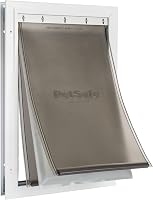
The PetSafe Extreme Weather Aluminum Dog Door, Large suits homes that need weather barriers and a manual closing panel. Its aluminum frame has reinforced corners, and PetSafe designs it for multi-pet households.
PetSafe says the flap system blocks 3 times more thermal energy than a standard pet door. The included slide-in panel gives you a way to close access when needed.
It fits most paneled, wood, PVC, and metal exterior doors measuring 1.5 to 2 in thick. Skip it if you need selective entry or your door falls outside that range.
Before allowing free access, confirm your dog can push through every layer and that the flaps settle closed afterward. Our guide to dog doors for cold weather helps you compare weather-focused options.
Who should choose the Baboni three-flap door?
The Baboni Plastic 3-Flap Dog Door, Large suits buyers who want a plastic-frame option with layered weather barriers. Choose it only after confirming both pet fit and installation thickness.
Its opening measures 10 1/4 in wide by 16 1/4 in high, and Baboni describes it for pets up to 100 lb. Use the opening measurements to judge comfort rather than relying on that weight limit.
Baboni gives conflicting thickness figures, so confirm the compatible range with Baboni before cutting. Skip this option if you need collar-controlled entry or can't resolve that fit question.
Don't confuse the frame dimensions, flap opening, and cutout dimensions. Each serves a different purpose, and only the installation template should guide the final cut.
Where should you install a dog door?
Choose a location with a secure outdoor destination, clear landings, and suitable mounting material. The easiest place to cut isn't always the safest place for your dog or home.
Compare a wall mount versus door mount dog door before committing. A wall changes the passage depth and may involve wiring or plumbing, so use a qualified installer when needed.
The PetSafe Electronic model supports interior or exterior door installation; wall installation requires a separate Wall Install Kit. Don't assume a door-mounted model can go into a wall without the required parts.
If you rent, get approval before making a permanent opening. For any installation, check the template's scale, measure the actual door thickness, and confirm clearances before cutting.
Follow the model's instructions for fasteners and sealing. After installation, check that the main door still shuts and locks normally and that the pet-door frame doesn't shift when pressed.
How can you make a dog door safer day to day?
A dependable routine combines access limits, clear paths, and regular checks. Decide who will close the door and handle bathroom breaks when free access ends.
Use these checks as part of normal pet care:
- Close access overnight or while away when the yard or opening can't be safely managed.
- Remove mud, leaves, and pet hair that stop flaps from closing.
- Check the frame, fasteners, panel, and flap edges for looseness or damage.
- Clear ice, standing water, and clutter from both approaches.
- Recheck gates and fences after storms or yard work.
- For electronic doors, maintain batteries and confirm each pet's access settings.
Check operation after cleaning or changing settings, with your dog nearby and supervised. For collar-key models, observe both entry and exit rather than assuming one successful pass confirms both.
Common mistakes include choosing by weight alone, leaving the panel unused, and treating a fenced yard as permanently secure. Reassess access as puppies grow, pets become less mobile, or conditions outside change.
Which dog door is safest for your home?
Dog doors can be safe when the pet, opening, and outdoor route all fit the plan. If any one of those fails, supervised bathroom breaks are the better choice.
Choose the PetSafe Electronic Pet Door, Collar Key Large for selective pet access if you're ready to manage keys and batteries. Choose the PetSafe Extreme Weather Aluminum Dog Door, Large for a compatible exterior door when weather protection and manual closure matter most.
Consider the Baboni Plastic 3-Flap Dog Door, Large when its opening fits your dog and you've resolved the thickness conflict. Skip installation if the route outside is unsafe or the required opening exposes nearby locks.
Before ordering, decide how you'll secure access every night and whenever your dog stays indoors. Use our dog door security options to check that final part of your plan.
Frequently asked questions
Are dog doors safe from burglars?
Dog doors can give someone a way to reach nearby locks or enter through a large opening; choose a comfortable pet-sized opening, assess its position from outside, and secure it when access isn't needed. A pet-access panel or collar sensor should not be treated as protection against forced entry.
Can wild animals come through a dog door?
Yes, wildlife and stray animals can enter through an accessible flap; keep food, treats, and trash away from the approach, and close the opening when your pet doesn't need it. Selective entry can reduce unwanted access, but another animal may follow your pet through before the door closes.
Do dog doors let cold air into the house?
Yes, dog doors can admit cold air through the flap or gaps around the frame; multiple flaps and magnetic seals can help reduce drafts, but the opening won't be airtight. Clean the flap edges, check that each flap closes fully, and inspect the frame seal when drafts appear.
Should I leave a dog door open at night?
Close the dog door at night when you can't supervise access or manage wildlife and yard hazards; plan a bathroom break before closing it and another when your dog needs one. Electronic access controls still require a secure outdoor area and a routine for checking that the door closes properly.